

Two years of research for better care for premature and newborn babies.
After two years of intensive research, the INTACT project has now been successfully completed. The focus was on developing new technologies to support premature and newborn babies with severe intestinal diseases.
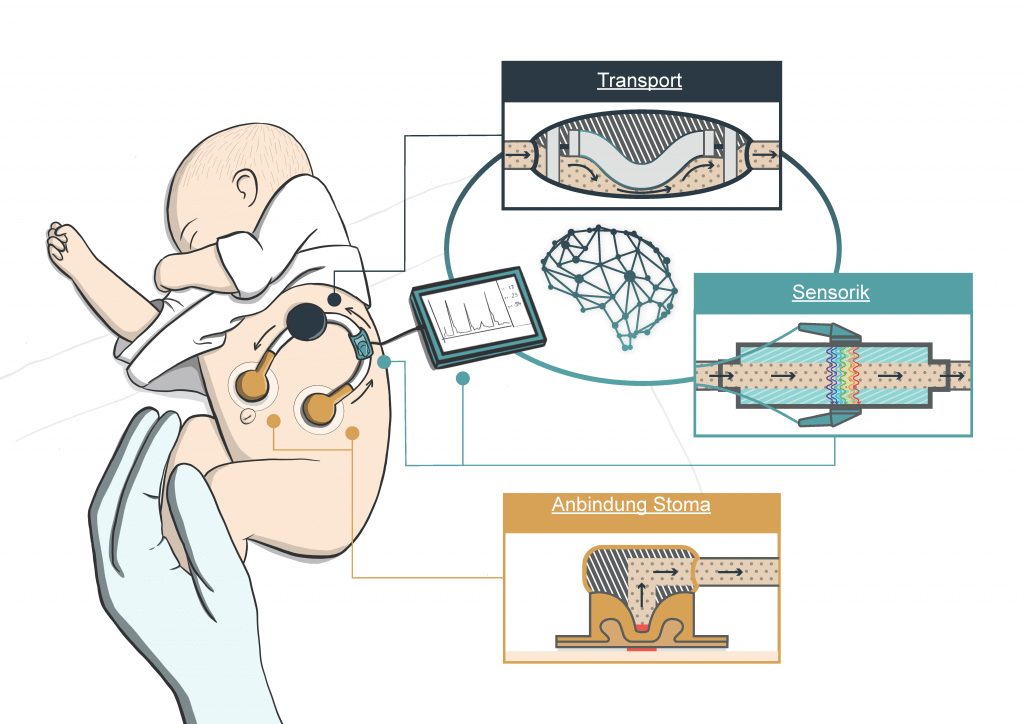
Intestinal pathology often requires surgical intervention, in which two ends of the intestine are brought out through the skin and connected to it (enterostomies). In order to preserve the downstream intestine and facilitate subsequent relocation, the intestinal contents—known as chyme—must be transferred from the feeding enterostomy to the draining enterostomy. Until now, this has been done manually, irregularly, and with considerable effort.
The goal of INTACT was therefore to research an intelligent, closed-loop system. This system would automatically transfer the chyme while simultaneously recording its quantity and composition in real time, thus enabling continuous, physiological supply.
At the end of the project, an initial platform prototype was presented that enables both real-time transport and combined spectroscopic and ultrasound-based analysis. This marked an important milestone – even though the development work ends at this point.
However, the knowledge gained lives on: Konstantin Gramatte is now using his experience from INTACT to provide new impetus for biophotonic research and medical technology in the TOOLS project.

